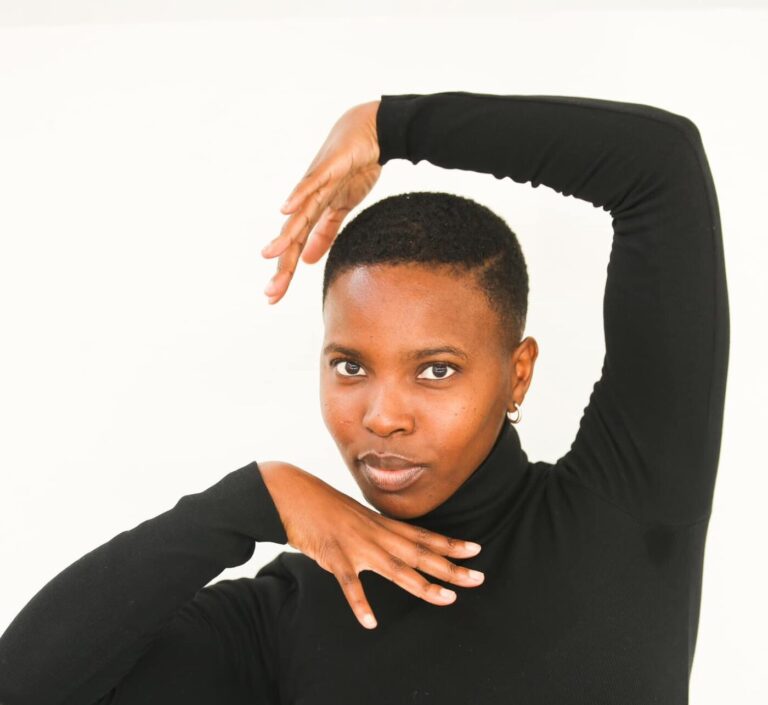
Olwethu Katase and Mahle Dlambulo on the Expresso Show
Olwethu Katase, Founder and Artistic Director of Igugu-lethu Arts and Leadership Project, and Mahle Dlambulo, Trainee Dance Teacher and UCT student, sat down with Graeme Richards and Carissa Cupido on the Expresso television show on 3 February 2025 to chat about our take on arts education, what sets us apart as an organisation, and what we envision for our learners. Read on and watch the interview below.

Carissa starts the interview by asking about the motivation behind the project and the decision to base it in Gugulethu. Olwethu explains, “The inspiration in starting Igugu-Lethu Arts and Leadership Project is to advocate for the importance of arts education in black townships, because a lot of black people think you can do dance as a hobby but not as a career. However, I’m sitting here today with an Honors degree in dance from UCT and I am employed by the Western Cape Education Department, so I’ve made a career out of dancing.” Moreover, Olwethu has three degrees and she has been specially invited to teach at San Francisco Ballet School, Alonzo King Lines Ballet, and ODC in the US (where she was the first-ever recipient of the African Exchange Dance Scholarship in 2018) and at the Royal Academy of Music in Denmark. She adds that the organisation is about “really trying to bring a new face and a new narrative when it comes to the arts to show that, actually, you can make something of your life through the arts.” Olwethu believes that, “If you have the mindset and goal that this is what I want to do and I don’t see myself doing anything else, then you can succeed in whatever it is that you set your mind to.”
I understand the power of dance and I know how it impacted my life positively, so why not give back to the community of Gugulethu… to plow back to where I come from.
Olwethu Katase
Mahle has been trained by Olwethu since he was 13. Now, he is studying Dance Pedagogy and African Gender Studies at the University of Cape Town and is a Trainee Dance Teacher at Igugu-lethu Arts and Leadership Project. Graeme asks what the arts have given him as a person. Here’s what Mahle had to say:
More than anything, dance has given me a voice to speak for myself—the confidence to speak and to always take up space wherever I go.
Mahle Dlambulo
He says dance has taught him to understand that, “You can be bright in a corner but what happens when all of you are under the same light? You have to go into the space, show up, and show off for yourself first before showing up for the next person.” Under Olwethu’s guidance, Mahle received a scholarship to the virtual Alonzo King Lines Summer Intensive Program of 2021. He was awarded an in-person fellowship to the 2022 Summer Intensive in San Francisco. So he is earnest when he asserts that, “The least you can do for yourself is to show up and not think that you’re doing the teacher a favour, but in fact you’re doing yourself a favour and you’re learning from the experience.”
Carissa asks Mahle to take us through his journey as someone who came from the organisation, what he’s studying, and where he sees himself going. He says, “My passion is in dance and I love dancing, performing, choreographing, and directing. But I also love queer politics and that’s where the African Gender Studies comes in, so that I understand the gender norms and how the politics around gender are positioned and try make a difference. And I make that difference through the arts, through the performances, directing, teaching and just bestowing seeds of love and wisdom to the next generation.”
When asked what she focuses on when building the programme and what she wants the youngsters to get out of it, Olwethu responds, “Responsibility, order, discipline. Exposing them to a life that is outside of their immediate environment.” She explains that she has formed an intentional relationship with the UCT Centre for Theatre, Dance, and Performance Studies, where she teaches the learners on Saturdays. “I know that most of them don’t even dream of going to UCT,” she adds, “however, when they step into the university and they see people who look like them, they start asking me, ‘Oh, I can actually study here?’ And I say, ‘Yes! You can study here. Here’s the proof’.”
There is a level of representation that is happening in this space that goes far beyond just getting a job or getting a position—there are soft skills here that are going to help you in life on a whole different level.
Graeme Richards
Another reason that Olwethu believes it’s important to take the learners to UCT is so that “when they actually get the opportunity to apply and they get accepted, it’s not a culture shock.” She explains, “As an organisation, we try to prepare them for the challenges they will face, because usually the English language becomes a barrier. Most of them are very intelligent, articulate learners; however, when it comes to communicating, they struggle.” This is why she offers English development classes, taught by Kamohelo Mabogwane, who has a master’s in English (summa cum laude) from UCT and is a professional editor. Olwethu adds that Kamohelo “teaches them public speaking, reading, and writing so that they have the confidence to stand in a space and present themselves confidently.”
It’s a really holistic programme—that’s what sets us apart. We’re not just teaching the kids how to do steps. We are really invested in the individual and we want them to excel and do well in life. We’re aware that not all of them are going to be dancers, but the skills they’re going to learn and be equipped with in the dance class are going to take them further in life in whatever career they choose for themselves.
Olwethu Katase
Graeme ends the interview by noting “the amount of threads that are being woven together. Here is a recipe for proven success!”